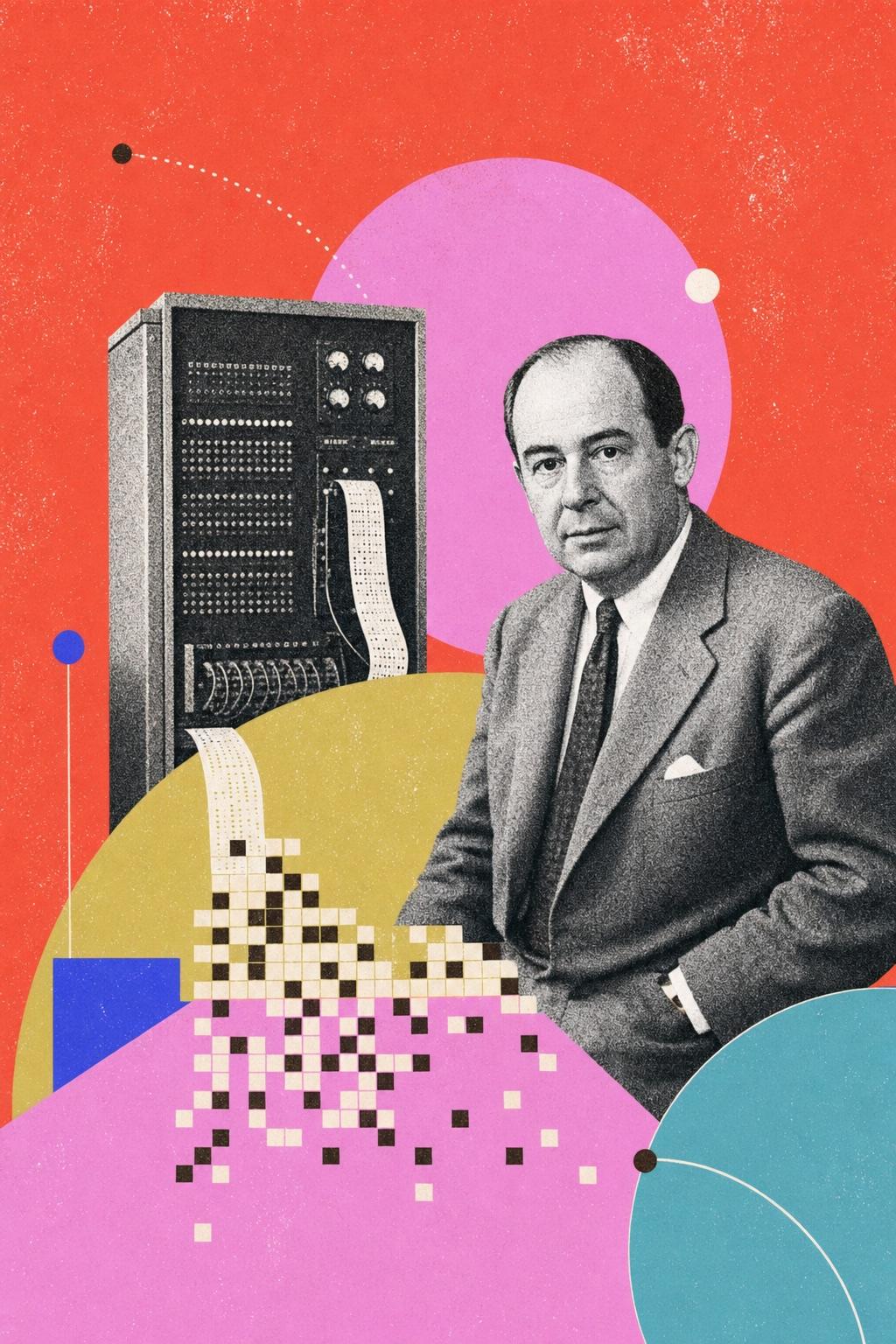
In the late 1940s John von Neumann, who had helped design the first stored-program computers, asked a question that sounds like biology: what is the simplest machine that can make a copy of itself?
The problem of the description
A machine that builds things needs instructions. If it is to build a copy of itself, the instructions must describe the whole machine, including the instructions. A naive description would have to contain itself, and so on forever.
Von Neumann's resolution was to split the machine in two. A universal constructor
and it first builds
The instructions are used twice: once interpreted, to build, and once copied, uninterpreted. This is exactly how DNA works, with ribosomes reading genes into proteins and polymerases copying them. Von Neumann described the logic in 1948, five years before Watson and Crick published the double helix.
Life on a grid
To make the idea precise without real machinery, von Neumann, following a suggestion from Stanisław Ulam, built his machine on a cellular automaton: an infinite grid of cells, each in one of a few states, all updated at once by the same local rule. His design used 29 states per cell and was published after his death, in 1966.
The most famous cellular automaton is far simpler. In John Conway's Game of Life (1970) each cell is alive or dead, and with
From this one line come gliders, guns, and patterns that compute anything a computer can. It is the clearest demonstration of von Neumann's insight that complexity, even reproduction, needs only simple parts and the right organisation.