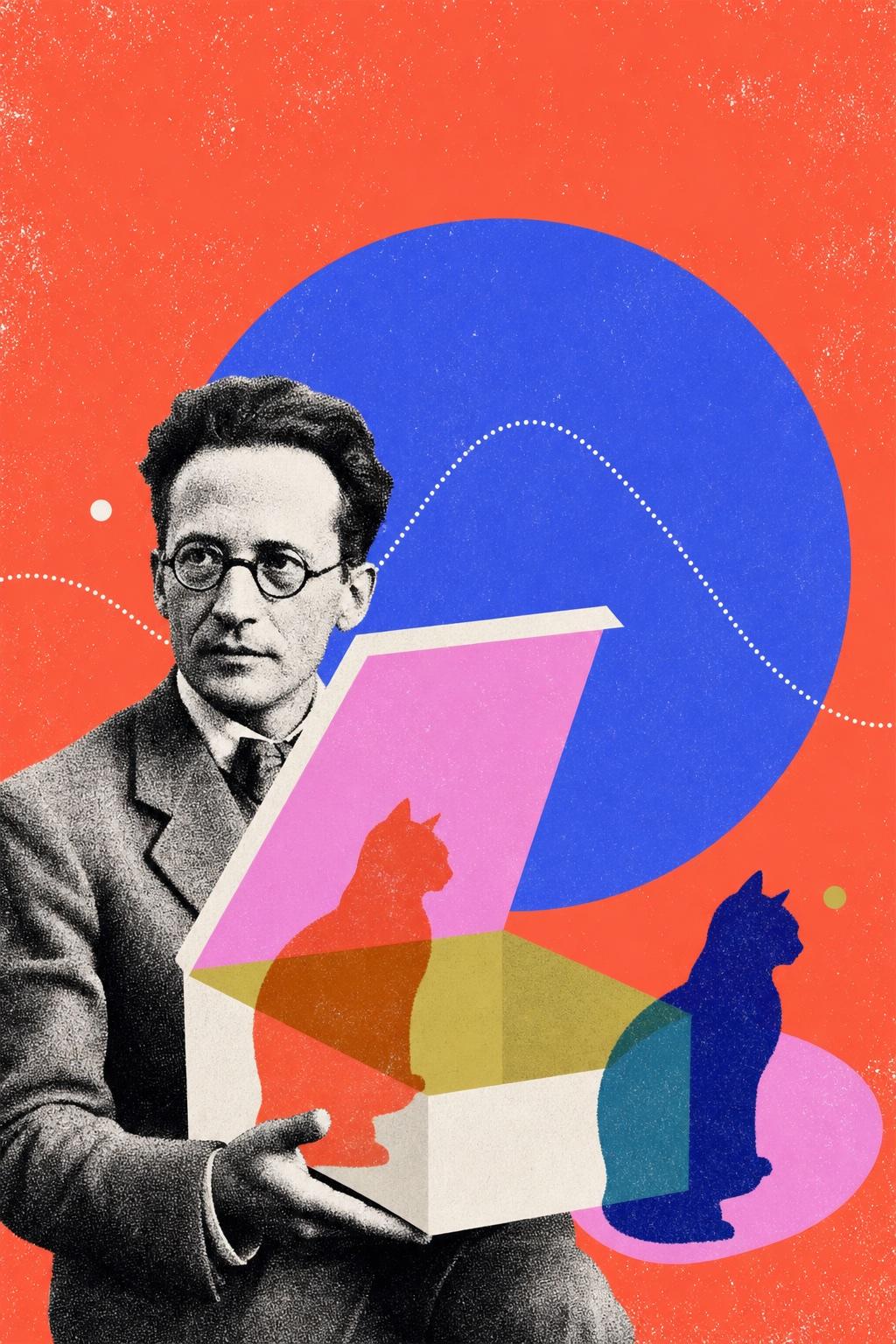
In 1935 Erwin Schrödinger proposed a deliberately absurd experiment. A cat is sealed in a box with a radioactive atom, a Geiger counter, and a flask of poison. If the atom decays, the counter fires, the flask breaks, and the cat dies. Quantum mechanics describes the atom, after an hour, as a superposition of decayed and not decayed. Followed to its conclusion, the theory seems to say the cat is a superposition too.
Superposition, written down
The state of the atom is a vector in a space of possibilities. After a time chosen so that decay has a fifty-fifty chance,
The state evolves smoothly under the Schrödinger equation,
which is linear: if each outcome evolves into a cat that is alive or dead, the superposition evolves into a superposition of the two cats,
The squares of the coefficients give the probabilities, here
Where the strangeness goes
The modern answer is decoherence. A cat is not isolated: it exchanges heat, light and air with everything around it, and each interaction records, in the environment, which branch it is in. Interference between the branches, the signature of a superposition, depends on the environment's records being identical, and they almost instantly cease to be. For an object the size of a cat, coherence is lost in a time far shorter than any experiment can resolve.
Decoherence explains why we never see interference between alive and dead. Whether it also explains why we see one particular outcome remains the open question that divides interpretations of quantum mechanics.
Cats in the laboratory
Physicists now build small Schrödinger cats on purpose: superpositions of large molecules flying through gratings, of millions of electrons circulating both ways round a superconducting loop, of microwave fields in a cavity. These "cat states" are the raw material of quantum computers, which work only while decoherence is held at bay.