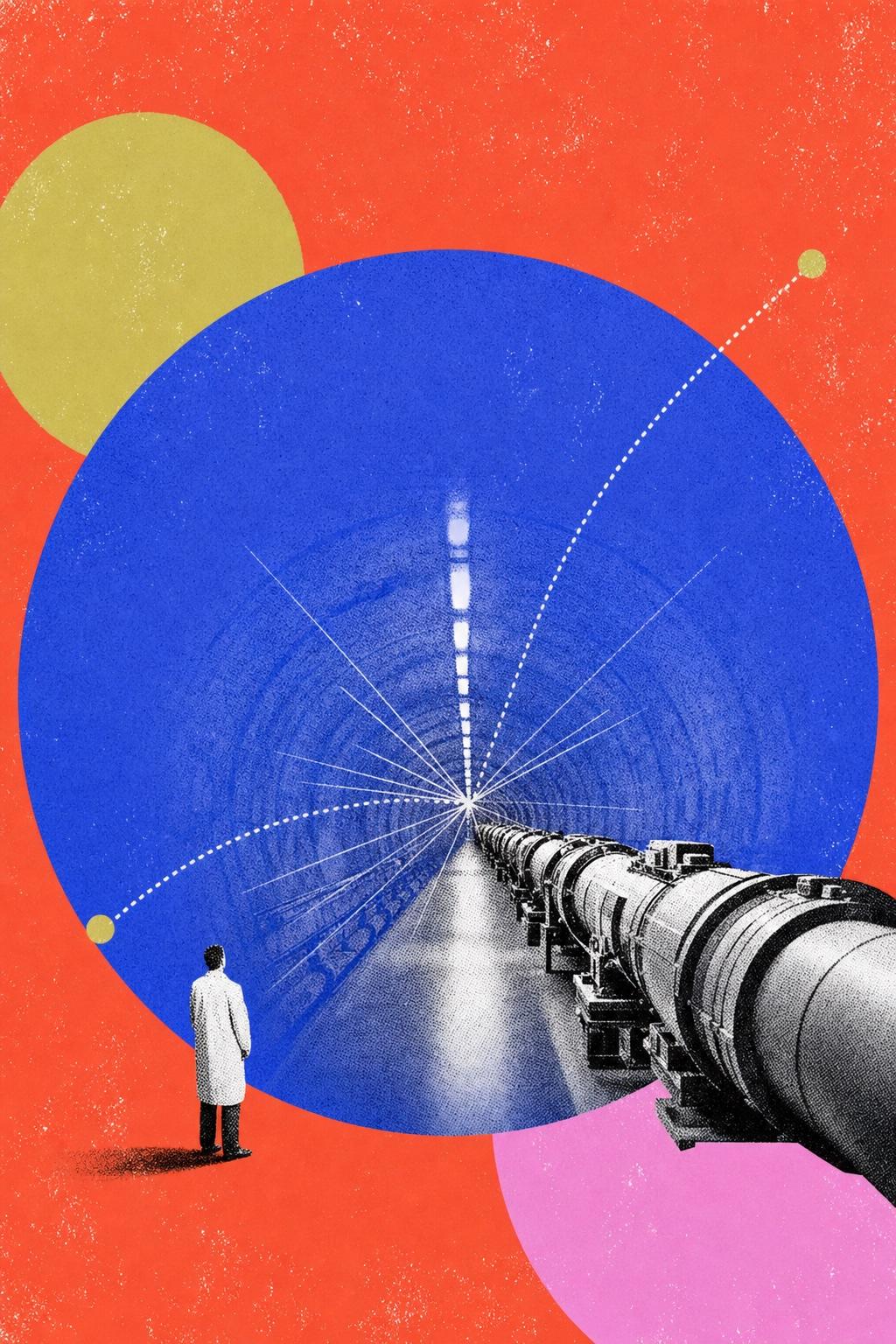
To see what matter is made of at the smallest scales, physicists smash it together as hard as they can. The Large Hadron Collider at CERN, a ring 26.7 kilometres around beneath the French–Swiss border, collides protons with a combined energy of 13.6 TeV.
Energy at nearly the speed of light
A proton's rest energy is
and the Lorentz factor
Bending with magnets
A charged particle in a magnetic field
To hold 6.8 TeV protons on a curve of about 2.8 km radius takes fields of about 8 tesla, more than 100,000 times Earth's field. The LHC uses 1232 superconducting dipole magnets, cooled with liquid helium to 1.9 K, colder than outer space. Higher energy needs either stronger magnets or a bigger ring, which is why proposals for the next collider run to about 90 km.
The cost of going round in circles
Charged particles radiate when they accelerate, and moving in a circle is acceleration. The energy lost per turn to synchrotron radiation grows as
For protons this loss is modest. For electrons, about 1836 times lighter,
Why collide at all
Head-on collisions make the full energy of both beams available to create new particles, measured by the centre-of-mass energy