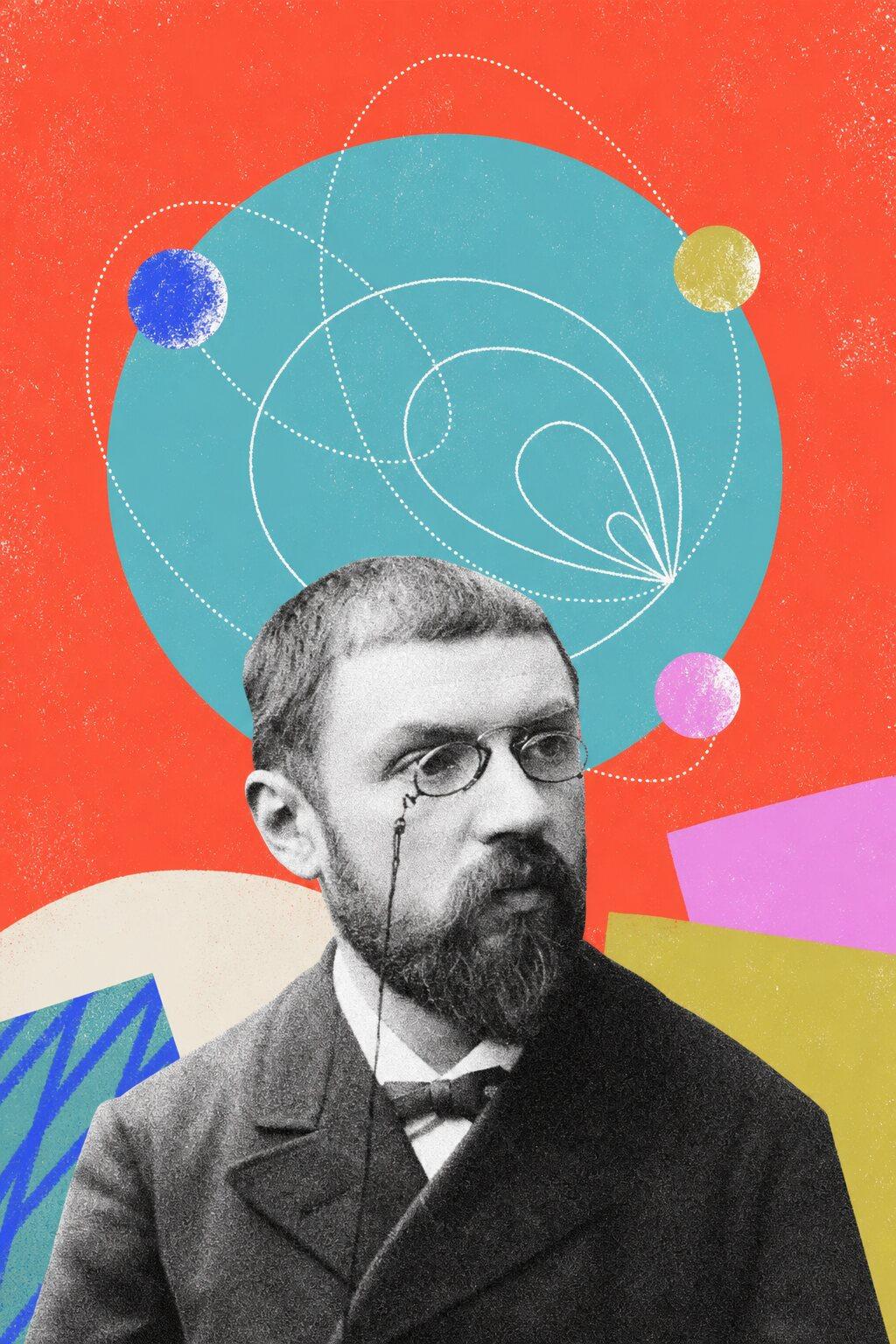
Henri Poincaré, born in Nancy in 1854, was perhaps the last mathematician who could claim to understand the whole of his subject. He wrote on differential equations, number theory, geometry, optics, electromagnetism and the philosophy of science, and in almost every field he left something that is still in use. His most surprising discovery came from a mistake, and from the honesty with which he fixed it.
A prize for the solar system
In 1885 King Oscar II of Sweden and Norway announced a prize, organised by the mathematician Gösta Mittag-Leffler, for progress on a set of hard questions. One asked whether the solar system is stable: will the planets go on circling the Sun for ever, or could one of them one day be flung out?
Each body pulls on every other by Newton's law of gravity:
For two bodies this can be solved exactly: the orbits are ellipses, as Kepler found. For three there is no general solution in a closed formula. Poincaré studied a simplified version, the restricted three-body problem, in which a tiny body moves under the pull of two large ones. In January 1889 his memoir won the prize.
The error, and what lay behind it
While the memoir was being prepared for publication in Mittag-Leffler's journal Acta Mathematica, the editor Lars Phragmén raised questions about some unclear passages. Working through them, Poincaré found a serious error. He had assumed that certain special paths, which approach and leave an unstable orbit, join up smoothly. They do not. They cross each other again and again, weaving a pattern so intricate that he later declined even to try to draw it.
The printed copies were recalled and destroyed, and Poincaré paid for the reprinting, which cost more than the prize money. The corrected memoir appeared in 1890. It was, in a sense, the first description of chaos: a system governed by exact, deterministic laws whose behaviour is so tangled that small causes have large effects.
Today we measure that sensitivity directly. Start two copies of a chaotic system at almost the same point, and the gap between them grows roughly as
The tool is modern, but the insight was Poincaré's. In Science and Method (1908) he wrote that small differences in initial conditions can produce very great ones in the final result, so that prediction becomes impossible. The same lesson reappears in a cellular automatonCellular automatonA grid of cells, each in one of a few states, all updated together in steps by the same simple rule based on their neighbours., where a simple rule on a grid can produce patterns that are hard to foresee without running it step by step. The prize memoir also contained his recurrence theorem: a bounded system of this kind will return arbitrarily close to its starting state. Ernst Zermelo later used it to challenge Boltzmann's account of entropyEntropyA measure of how many microscopic arrangements fit what we observe of a system; loosely, its disorder, or the information we are missing., which says that such systems run one way only.
The shape of space
Poincaré's way of thinking about orbits, as shapes in a space of possibilities rather than as formulas, led him to found a new subject. In Analysis Situs (1895) and its supplements he laid the foundations of what we call topology, the study of the properties of shapes that survive stretching and bending.
In 1904 he asked a question that took a century to answer. On the surface of a sphere, every loop can be shrunk to a point; on a doughnut, a loop around the hole cannot. Is a three-dimensional space in which every loop shrinks, and which is finite and has no edge, necessarily a three-dimensional sphere? This became the Poincaré conjecture. Grigori Perelman proved it in papers posted in 2002 and 2003, building on Richard Hamilton's Ricci flow. He declined both the Fields Medal and the Clay Institute's million-dollar prize.
Close to relativity
Poincaré also came remarkably near to special relativity. In 1898 he argued that simultaneity at different places is not self-evident but must be defined, for instance by exchanging light signals. In 1905 he gave the Lorentz transformations their name and showed that they form a mathematical group, and in a longer paper he combined space and time into a set of four coordinates. Einstein's paper of the same year took the decisive step of making the principle of relativity the foundation of physics. Poincaré died in Paris in 1912, having shown that even the clockwork heavens hold surprises.