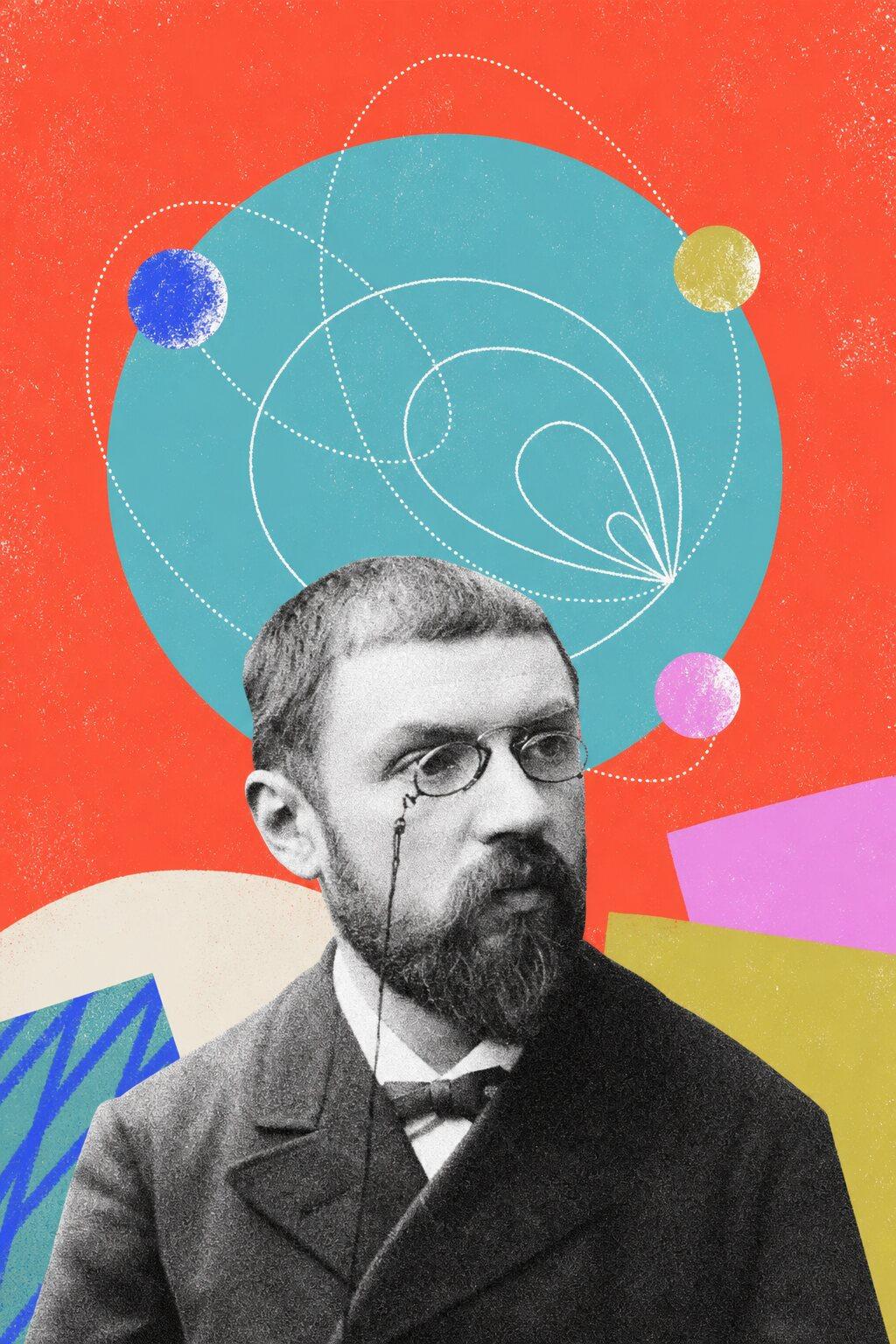
Why is energy conserved? For most of the history of physics the honest answer was that it simply is: careful measurement showed it, and the laws were written to respect it. In 1918 a mathematician at Göttingen gave a deeper answer. Energy is conserved because the laws of physics are the same today as they were yesterday. That mathematician was Emmy Noether.
A mathematician without a post
Noether was born in Erlangen in 1882, the daughter of the mathematician Max Noether. Women were then barely allowed to attend German universities, and she studied at first only as a guest, before earning her doctorate at Erlangen in 1907. For years she worked there without pay.
In 1915 David Hilbert and Felix Klein invited her to Göttingen, then the centre of the mathematical world. They wanted her expertise on invariants, quantities that stay the same when something is transformed, to help with problems arising in Einstein's new theory of gravity. The university resisted giving a woman the right to lecture. Hilbert argued, famously, that the candidate's sex was no reason to refuse her, and for several years her courses were advertised under his name. She was finally granted the right to lecture in 1919.
The theorem
The problem Hilbert and Klein had in mind was how energy is conserved in general relativity. Noether's answer, in a paper presented in 1918, went far beyond it, and it is easiest to see in the language of the Lagrangian, a single function
Now suppose the Lagrangian does not change when every coordinate is shifted a tiny amount
The cases are striking. If the laws are the same everywhere, so that sliding the whole system along changes nothing,
The same idea reaches into the quantum world. In quantum electrodynamicsQuantum electrodynamicsThe quantum theory of how electrically charged particles, such as electrons, interact with light, and the most precisely tested theory in physics., a symmetry in the phase of the electron's field gives the conservation of electric charge. Even when a symmetry is hidden, as in spontaneous symmetry breakingSpontaneous symmetry breakingWhen the laws governing a system are symmetric but its lowest-energy state is not, so the system settles into one option and hides the symmetry., the laws keep it, and Noether's reasoning still guides what follows.
Algebra made abstract
For Noether herself, the theorem was a side road. Her main work, from the 1920s on, was in algebra. Instead of calculating with particular numbers or polynomials, she studied the structures they belong to, such as rings and ideals, by their most general properties. Her 1921 paper on ideals in rings introduced the condition that now gives us Noetherian rings, and her ideas, spread by her students and by van der Waerden's influential textbook Moderne Algebra, shaped the way algebra is taught today.
In 1933 the Nazi government dismissed her, as a Jewish woman, from Göttingen. She moved to the United States, to Bryn Mawr College, and lectured at the Institute for Advanced Study in Princeton. She died in 1935, after surgery, at the age of 53.
Soon afterwards Albert Einstein wrote to the New York Times in her memory. He wrote that, in the judgement of the most competent living mathematicians, she was the most significant creative mathematical genius produced since women's higher education began, and praised the methods she had found as being of great importance to the younger generation of mathematicians. Every time a physicist asks what a new symmetry conserves, her name is in the answer.