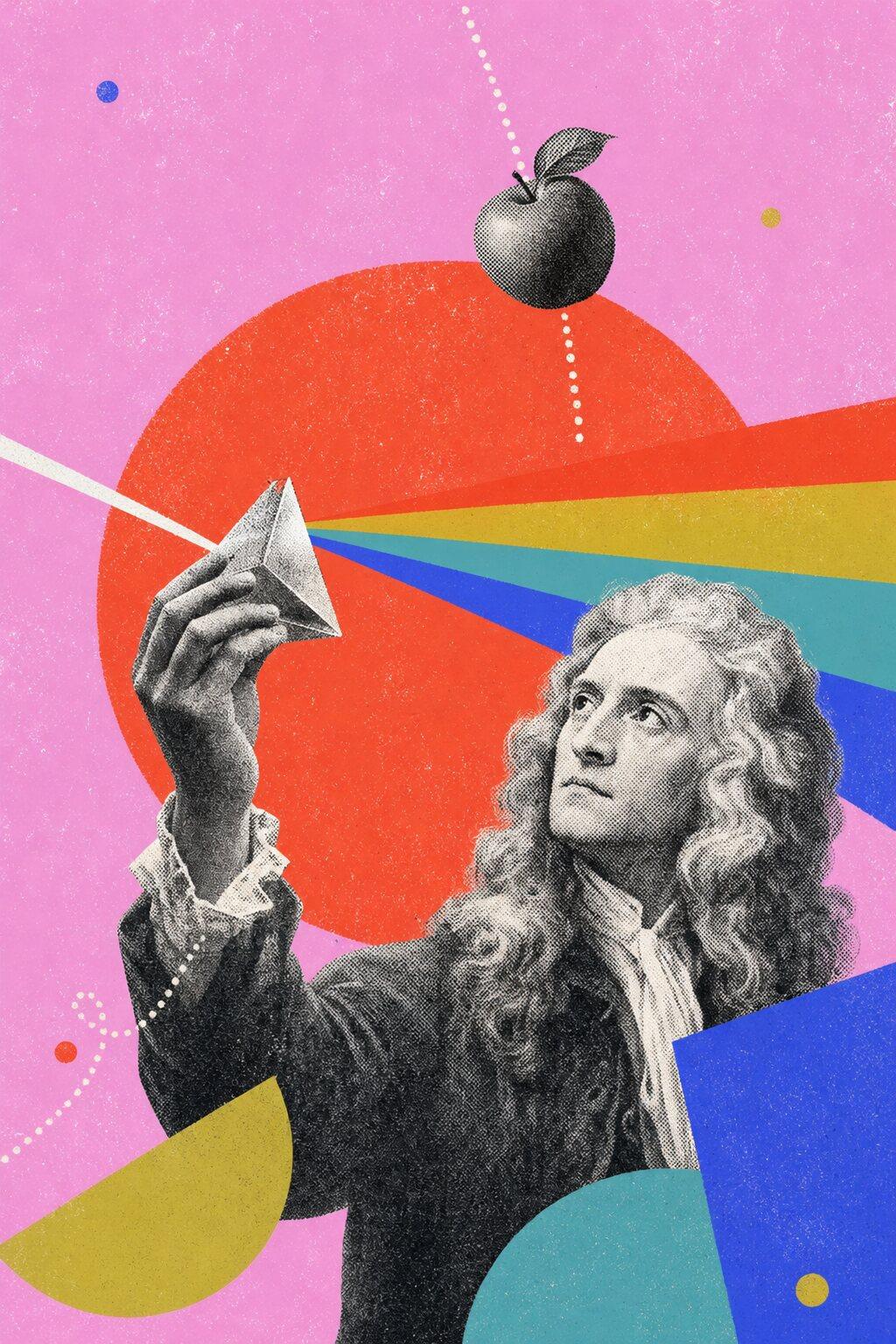
The story everyone knows is the apple. Newton told a version of it himself, in old age, to his friend and biographer William Stukeley. But the image of a sudden flash of genius under a tree hides the real man: a solitary, intensely private worker who made his own instruments and whose interests ranged far beyond what we now call science. Isaac Newton was born in Woolsthorpe, Lincolnshire, on Christmas Day 1642 by the calendar then used in England. By the time he died in 1727 he had changed how humanity understands nature.
Light, colour and a prism
In 1665 plague closed the University of Cambridge, and the young Newton went home to Woolsthorpe. Over the next two years he laid the foundations of his work on light, mathematics and motion. With prisms he showed that white light is not pure but a mixture of colours, which a prism separates because each colour bends by a different amount. His decisive test passed a single colour through a second prism: it bent again, but did not change colour. Colour belonged to the light, not to the glass.
The finding led him to design a telescope that used a curved mirror instead of a lens, avoiding the coloured fringes that lenses produce. The reflecting telescope he built won him election to the Royal Society in 1672, and his paper on light and colours appeared the same year. He also studied the coloured rings that appear where a curved lens rests on flat glass, now called Newton's rings. We understand them today as interferenceInterferenceThe adding together of waves, or quantum amplitudes, so that they reinforce in some places and cancel in others, producing light and dark stripes. of light waves, although Newton himself thought of light as a stream of particles, a view that held sway until Thomas Young's double-slit experimentDouble-slit experimentAn experiment in which waves or particles pass through two narrow openings and build up a striped interference pattern on a screen beyond. in the early 1800s.
The method of fluxions
Over the same plague years Newton developed what he called the method of fluxions, which we know as calculus. It is a way of finding how fast a quantity changes at an instant, and of adding up infinitely many infinitely small pieces. He kept it largely to himself. Gottfried Wilhelm Leibniz developed calculus independently and published first, in 1684, with the notation we still use. The quarrel over priority became one of the bitterest in the history of science, and Newton, then President of the Royal Society, quietly wrote much of the Society's official report on the matter himself.
The Principia
In 1684 the astronomer Edmond Halley visited Newton in Cambridge to ask what path a planet would follow if the Sun pulled on it with a force that weakens as the square of the distance. Newton replied that it would be an ellipse; he had calculated it. Halley urged him to publish, and paid for the printing himself. The result, the Philosophiæ Naturalis Principia Mathematica, appeared in 1687. It set out three laws of motion. The second, in modern notation, reads
The first law says that a body left alone keeps moving in a straight line at a steady speed, and the third that every action has an equal and opposite reaction. Alongside them came the law of universal gravitation:
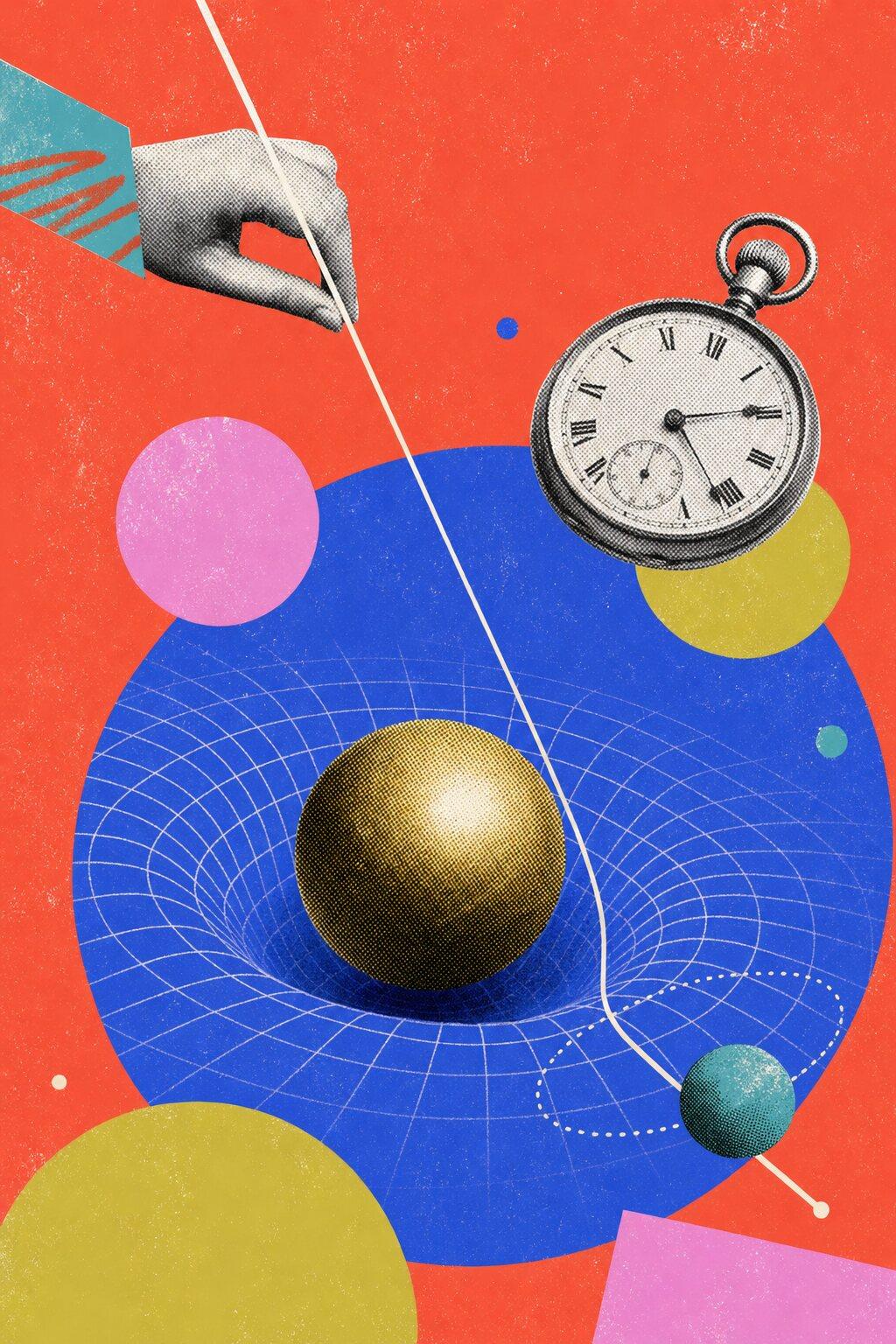
The word that mattered was universal. The force that brings an apple to the ground is the same force that holds the Moon in its orbit and the planets around the Sun. Newton checked it against the Moon itself: sixty times farther from the Earth's centre than an apple, its fall towards the Earth should be 3,600 times weaker, and it is. The constant
Alchemist and Master of the Mint
Newton wrote more about alchemy and theology than about physics, about a million words on alchemy alone, by most estimates, much of it never meant for publication. When the economist John Maynard Keynes bought a large collection of these papers, he concluded that Newton "was not the first of the age of reason. He was the last of the magicians."
In 1696 Newton left Cambridge for London to become Warden of the Royal Mint, and in 1699 its Master, a post he held until his death. He took the work seriously, overseeing a recoinage and personally pursuing counterfeiters, several of whom were hanged. He was knighted in 1705. Difficult, suspicious and fiercely protective of his work, he was also capable of extraordinary sustained thought. The apple may have been real. The genius was in the years of work that followed.