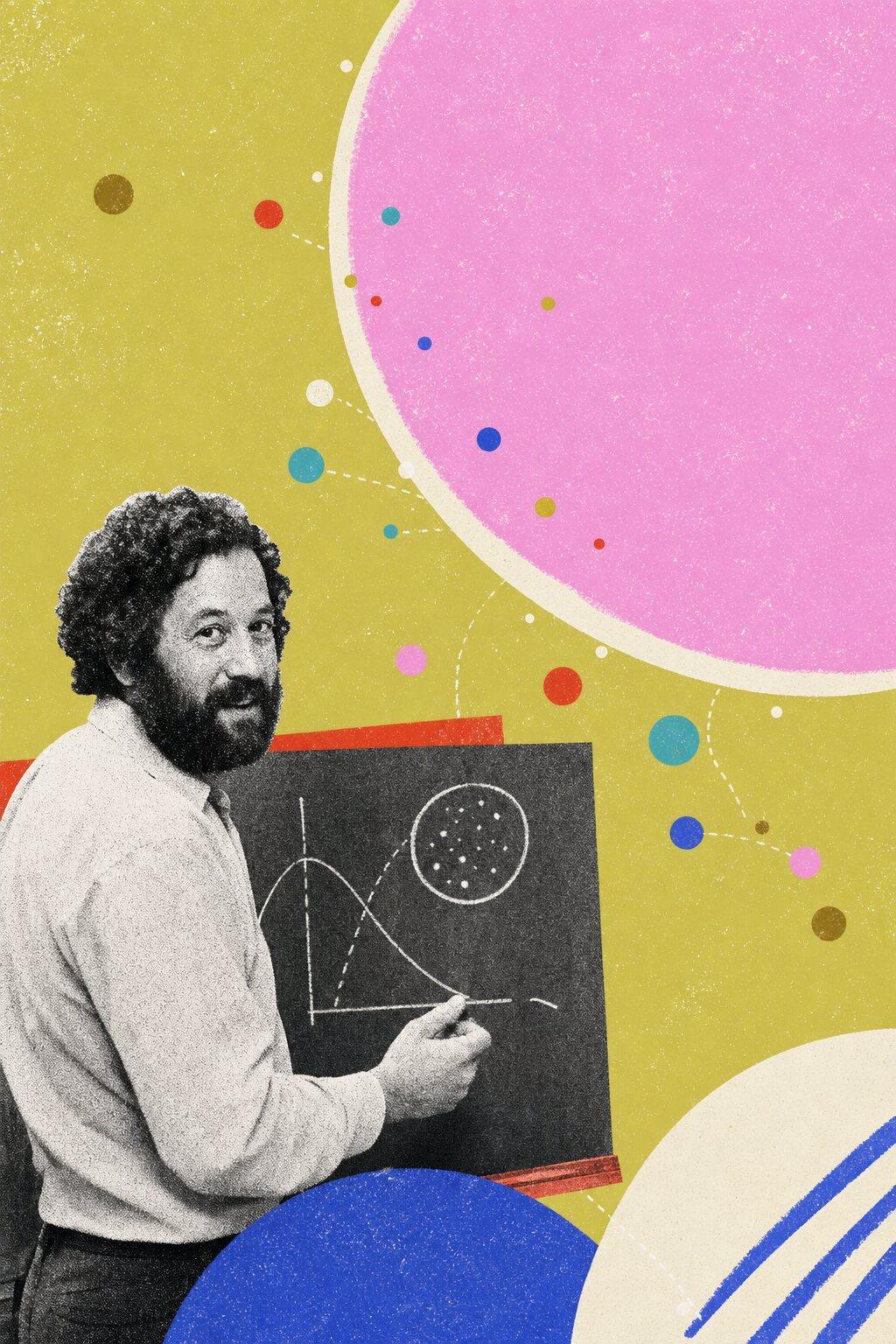
Sidney Coleman spent most of his working life at Harvard, thinking about the emptiest thing there is. Born in Chicago in 1937, he took his doctorate at Caltech under Murray Gell-Mann and joined the Harvard faculty in the early 1960s, where he stayed until his death in 2007. He wrote fewer papers than many of his peers, but an unusual number of them changed how physicists think, and his lectures became legends in their own right.
The vacuum is a state, and states can change
In quantum field theory the vacuum is not nothing. It is the lowest-energy arrangement of all the fields that fill space, such as the Higgs fieldHiggs fieldA field filling all of space whose non-zero value in empty space gives the W and Z bosons, quarks and electrons their mass.. A field can have more than one resting place. Picture a ball in a landscape with two hollows, one shallower than the other. A ball in the shallow hollow looks perfectly settled. In everyday physics it would stay there for ever. In quantum physics it can tunnel through the hill into the deeper hollow.
Physicists call the shallow hollow a false vacuum and the deeper one the true vacuum. The question Coleman asked in his 1977 paper "The Fate of the False Vacuum" was simple: if the universe sits in a false vacuum, how does it decay, and how fast?
Bubbles of a different world
His answer was that the change cannot happen everywhere at once. Instead, by quantum tunnelling, a small bubble of true vacuum appears somewhere at random. Coleman found that the chance of this, for each unit of volume and each second, takes the form
Not every bubble survives. Its wall costs energy, in proportion to its area, while its inside releases energy, in proportion to its volume. Small bubbles lose that contest and shrink away. In the common case where the wall is thin compared with the bubble, Coleman showed that a bubble lives and grows once it passes a critical radius, and that the barrier is fixed by the same two quantities:
A bubble that passes the critical size expands at nearly the speed of light, converting everything it meets. Coleman, with Frank De Luccia, later worked out how gravity changes the picture. The idea has never gone away: measurements of the Higgs boson and top quark masses suggest that our own vacuum may be only metastable, though with a lifetime so long that nobody needs to worry.
What symmetry cannot do
Ten years earlier, in 1967, Coleman and Jeffrey Mandula had proved a theorem that set the rules for a whole field. Physicists hoped to unify two kinds of symmetry: the symmetries of space and time, such as rotations and shifts, and the internal symmetries that relate different particles. The Coleman–Mandula theorem showed that, under very general assumptions about how particles scatter, the two can only sit side by side. They cannot be mixed into one larger symmetry.
Like many good no-go theorems, it was most useful for its loophole. The theorem assumed symmetries built from ordinary commuting quantities. Relax that, and a new kind of symmetry becomes possible, one that relates force particles to matter particles. That is supersymmetry, and the theorem that allows it, by Haag, Łopuszański and Sohnius in 1975, is usually read as the answer to Coleman and Mandula.
Coleman also showed, with Erick Weinberg in 1973, how quantum effects alone can trigger spontaneous symmetry breakingSpontaneous symmetry breakingWhen the laws governing a system are symmetric but its lowest-energy state is not, so the system settles into one option and hides the symmetry., a mechanism still used in models of the early universe.
The teacher
For many physicists, Coleman's real monument is his graduate course on quantum field theory, taught at Harvard for decades. The lectures were recorded on video, and the notes were copied and passed from hand to hand. They were edited and published as a book in 2018, and his summer-school lectures were collected in Aspects of Symmetry in 1985. He built the subject from the ground up, from single particles to the Feynman diagramFeynman diagramA picture made of lines and vertices that stands for one exact term in the calculation of how particles interact. and beyond, with unusual clarity.
He was also very funny. His remark that the career of a young theoretical physicist consists of treating the harmonic oscillator in ever-increasing levels of abstraction is still repeated in physics departments. His wit was a way of making hard ideas memorable, and of reminding his students that the deepest questions about empty space could be asked with a smile.