In 1907, two years after special relativity, Albert Einstein had what he later called the happiest thought of his life. A person falling freely from a roof, he realised, would not feel their own weight. It took him eight years to follow that thought to its end. In November 1915 he presented the result to the Prussian Academy of Sciences in Berlin: a theory in which gravity is not a force at all, but the curvature of space and time.
Falling is floating
The starting point is the equivalence principle. Inside a sealed lift falling freely, everything floats: you, your keys, a dropped apple. No experiment inside the lift can tell that you are falling. Conversely, a lift accelerating upwards in deep space would press you to the floor exactly as gravity does. Gravity and acceleration are, locally, indistinguishable.
All bodies fall at the same rate, whatever their mass. In Newton's theory this is a coincidence: the mass that resists being pushed happens to equal the mass that gravity pulls on. Einstein made it the foundation. If everything falls the same way, the falling may be a property of the stage itself rather than of the actors on it.
Matter and curvature
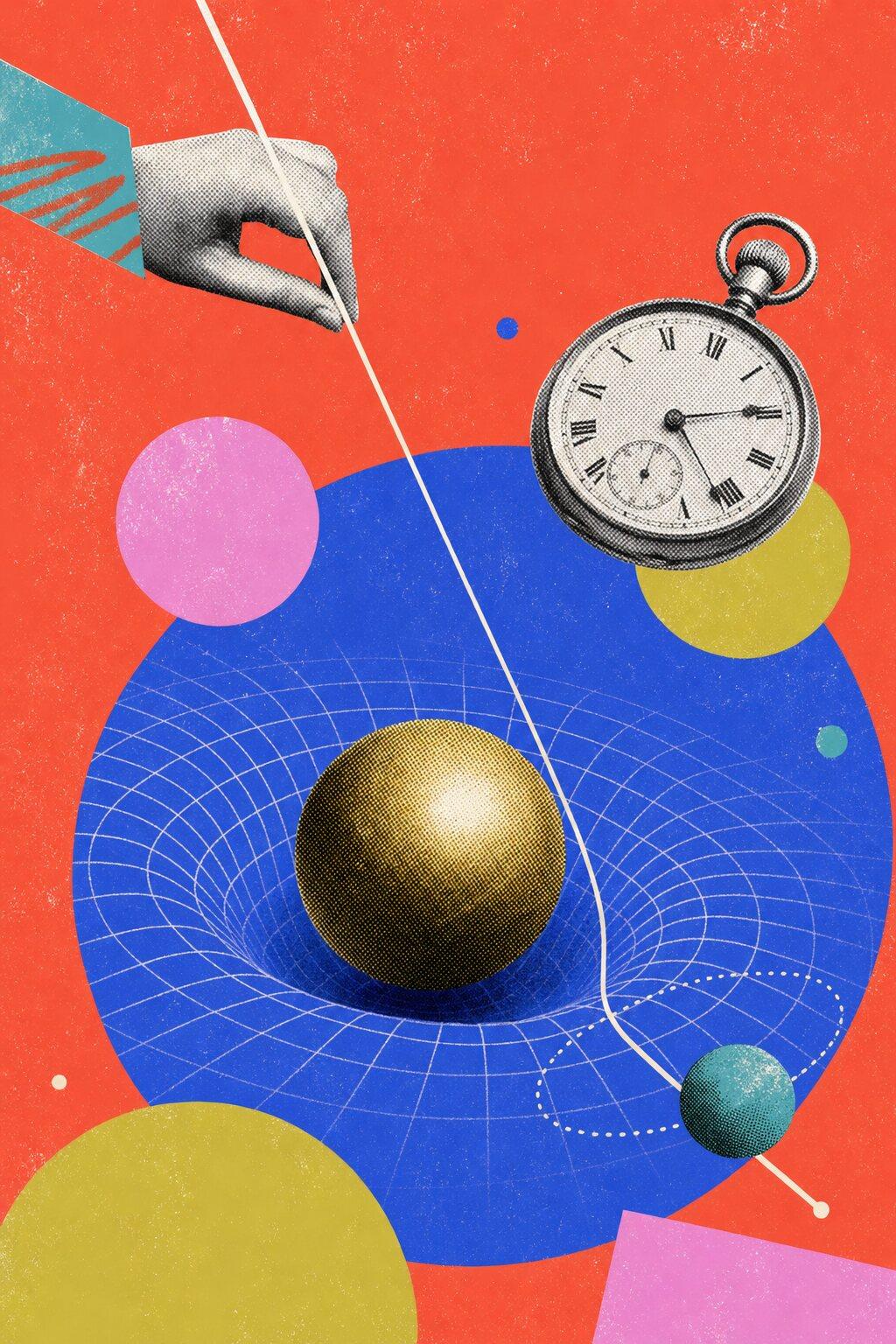
The stage is spacetime, the four-dimensional combination of space and time that special relativity had already welded together. In general relativity it can curve. Objects with no force acting on them follow the straightest possible paths through it, and when spacetime is curved, those paths bend. The Earth orbits the Sun not because it is pulled, but because it is following the straightest route through the curved spacetime the Sun creates. John Wheeler summed it up in a famous line: "Spacetime tells matter how to move; matter tells spacetime how to curve."
The second half of that sentence is Einstein's field equations. Written compactly, they are
This compact line hides ten linked equations. Far from strong gravity they reduce to Newton's law. Close to the Sun, or near a black hole, they differ, and the differences can be measured.
Three early tests
The first was Mercury. Its elliptical orbit slowly turns, so that its point of closest approach to the Sun shifts a little each time round. Most of that shift comes from the pull of the other planets, but about 43 arcseconds per century had no Newtonian explanation. In November 1915 Einstein calculated what his theory predicted. It was 43 arcseconds per century.
The second was light. Curved spacetime bends the path of starlight passing the Sun, by 1.75 arcseconds at the Sun's edge, twice the value a Newtonian argument gives. During the total eclipse of 29 May 1919, expeditions organised by Frank Dyson and Arthur Eddington photographed stars near the darkened Sun from Sobral in Brazil and the island of Príncipe off West Africa. Their measurements favoured Einstein's value, and he became famous almost overnight.
The third is time itself. Clocks deeper in a gravitational field run slower. For a clock outside a planet,
From GPS to gravitational waves
That formula is at work whenever you use satellite navigation. GPS satellites orbit about 20,000 kilometres up, where gravity is weaker, so their clocks gain about 45 microseconds a day on clocks on the ground. Their orbital speed slows them by about 7, as special relativity predicts, leaving a net gain of about 38 microseconds a day. Light travels more than eleven kilometres in that time. Without correcting for relativity, positions would drift by kilometres within a day.
The theory's most dramatic prediction took a century to confirm. Accelerating masses should send ripples through spacetime itself. On 14 September 2015 the two LIGO detectors in the United States, each an L-shaped laser instrument with arms four kilometres long, recorded a passing wave. It came from two black holes, each around thirty times the mass of the Sun, merging more than a billion light years away. The detectors measure the wave by interferenceInterferenceThe adding together of waves, or quantum amplitudes, so that they reinforce in some places and cancel in others, producing light and dark stripes. between laser beams, and the change in arm length was less than a hundredth of the width of a proton. Rainer Weiss, Kip Thorne and Barry Barish shared the 2017 Nobel Prize for the discovery.
General relativity has passed every test so far. Yet it still refuses to merge with quantum theory, which describes the other forces so precisely in theories such as quantum electrodynamicsQuantum electrodynamicsThe quantum theory of how electrically charged particles, such as electrons, interact with light, and the most precisely tested theory in physics.. Joining the two remains one of the great unfinished tasks of physics.