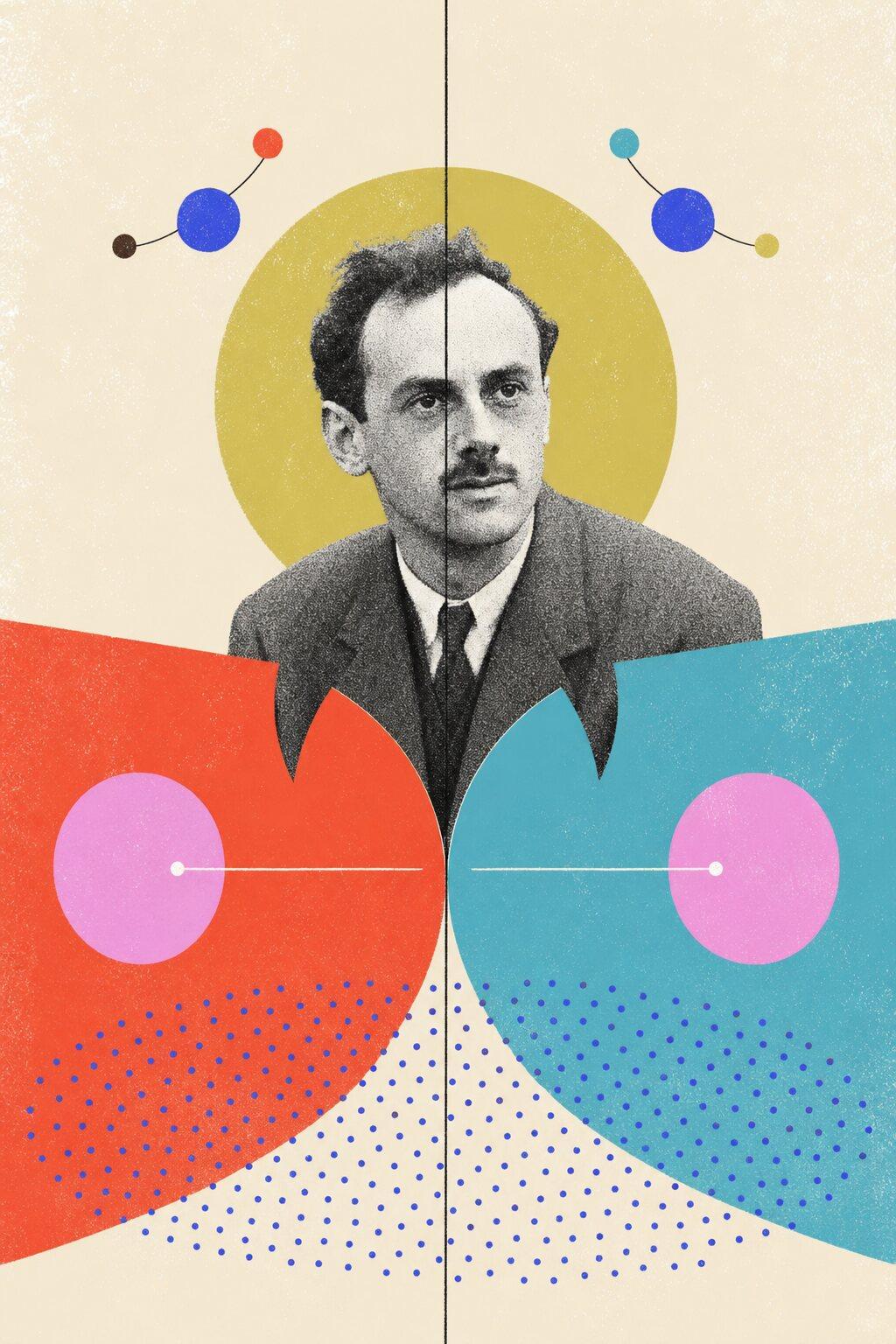
Paul Dirac was born in Bristol in 1902 and trained first as an electrical engineer. By his mid-twenties he was one of the handful of people reshaping physics, and in 1928 he published what many physicists regard as the most beautiful equation of the twentieth century. It described the electron, and it said more than its author intended. Hidden inside it was the first sign that every kind of matter has a mirror image.
A problem of fit
By 1926 the Schrödinger equationSchrödinger equationThe basic equation of quantum mechanics, which says how a system's wavefunction changes smoothly over time. described atoms with great success, but it was not compatible with Einstein's special relativity. It treats time and space differently, while relativity insists they belong together. The natural relativistic starting point is the relation between a particle's energy, momentum and mass:
Turning this directly into a quantum equation gives a wave equation now named after Oskar Klein and Walter Gordon. Dirac disliked it. Because it involves the energy squared, it led to probabilities that could come out negative, which makes no sense. He wanted an equation that, like Schrödinger's, involved only the first rate of change in time, yet treated space and time alike. No ordinary numbers could do it. Dirac found that it worked if the coefficients were small arrays of numbers, matrices, and the wavefunctionWavefunctionThe mathematical object that describes a quantum system's state, from which the probabilities of every possible measurement outcome can be calculated. had four components instead of one. The result was
Spin for free
The first surprise was spin. Experiments had shown that electrons behave like tiny magnets with an intrinsic angular momentum, and physicists had added this property by hand. In Dirac's equation it simply appeared, a consequence of making quantum mechanics fit relativity. The equation also predicted the strength of the electron's magnetic momentMagnetic moment (g-factor)A measure of how strongly a particle behaves like a tiny bar magnet; its g-factor compares that strength with a simple classical expectation., a value of exactly 2 for what physicists call the g-factor. Nature agrees to about one part in a thousand; the tiny difference was later explained by quantum electrodynamicsQuantum electrodynamicsThe quantum theory of how electrically charged particles, such as electrons, interact with light, and the most precisely tested theory in physics., the theory that grew from Dirac's work.
The trouble with negative energy
The second surprise looked like a disaster. Because energy enters squared, the equation allows solutions with negative energy as well as positive. An ordinary electron should be able to fall into those states, releasing light, and every atom would collapse. Dirac's bold answer, around 1930, was that the negative-energy states are already filled, an invisible sea of electrons everywhere. A gap in that sea, a missing negative-energy electron, would behave like a particle with the electron's mass but the opposite charge.
He first hoped the gap might be the proton, but the masses did not match. In 1931 he accepted the conclusion his equation demanded: there must be an anti-electron, a new particle as yet unseen.
In 1932 Carl Anderson, studying cosmic rays at the California Institute of Technology with a cloud chamber in a strong magnetic field, photographed a track that curved the way an electron's would, but in the opposite direction. He had found the positron. Anderson was not looking for Dirac's particle, but it was exactly what Dirac had predicted. Antimatter was real. The picture of a filled sea has since been replaced by quantum field theory, but the prediction stands: every particle has an antiparticle.
A man of few words
Dirac was famously sparing with words. His Cambridge colleagues joked about a unit of conversation, the "dirac", equal to one word per hour. He answered questions literally and briefly, and preferred to think alone. In 1932 he became Lucasian Professor of Mathematics at Cambridge, the chair once held by Isaac Newton, and in 1933 he shared the Nobel Prize in Physics with Erwin Schrödinger. He was 31.
He considered turning the prize down because he disliked publicity, and was persuaded that refusing would attract even more. Dirac died in Tallahassee, Florida, in 1984. A memorial stone in Westminster Abbey carries his equation in its most compact form,